by admin - December 5th, 2018
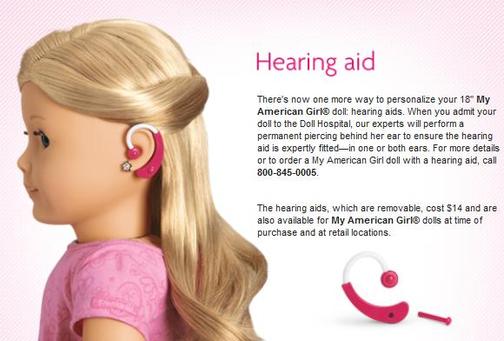 The American Girl store is taking an amazing extra step in doll care and customization! Apart from having a special place to have your dolls freshened up at their doll hospital, the company has added a special feature to their 18″ American Girl doll, they can now be fitted for their very own custom hearing aid!
We know that hearing loss can happen at any age and we are so happy to see such an amazing addition to an already popular doll, what a way to help our little ones become comfortable in their hearing aids!
To find out more about these unique features visit the America Girl Doll Hospital website at
This is a preview of
American Girl Dolls Now Have Optional Hearing Aids
.
Read the full post (108 words, 1 image, estimated 26 secs reading time)
Filed: Uncategorized | Comments Off on American Girl Dolls Now Have Optional Hearing Aids
by admin - October 1st, 2018
From Breastcancer.org
Hearing problems can include hearing loss and ringing in your ears (tinnitus). Hearing problems can occur naturally and gradually as you get older, but they also can be a side effect of some breast cancer treatments.
Signs you may have a hearing problem:
- Hearing sounds (ringing, buzzing, humming, or whooshing) in your ear when no external sounds are present. The noises may vary in pitch or switch from ear to ear.
- The sounds are loud enough to interfere with your concentration or muffle or distort surrounding noises.
Filed: Uncategorized | Comments Off on Dealing with Hearing Loss after Cancer
by Kyle - October 1st, 2018
Contributed by Lisa Packer, staff writer, Healthy Hearing
September 6, 2016
It has long been known that certain chemotherapy drugs are associated with hearing loss. But now for the first time, a new study at Indiana University has found a correlation between higher doses of a commonly used drug and increased hearing loss.
Cancer survivors risk increased hearing loss.
This is a preview of
Study looks at Hearing Loss in Cancer Survivors
.
Read the full post (816 words, estimated 3:16 mins reading time)
Filed: Uncategorized | Comments Off on Study looks at Hearing Loss in Cancer Survivors
by admin - September 9th, 2015
The ‘hearing loop’ is a remarkable advance, but all too hard to find in the U.S.
By DAVID G. MYERS
Updated Aug. 27, 2015 7:24 p.m. ET
The first time I clicked on my hearing aids’ telecoils, it seemed like magic. It was 1999 and my wife and I were sitting in a historic abbey on Scotland’s Isle of Iona. I had gradually become hard of hearing and had gotten my first hearing aid in my 40s, and the abbey wasn’t built with acoustics in mind. The amplified voice of the worship leader caromed off the stone walls, reverberating into a fog by the time it reached my ears.
This is a preview of
A Technological Godsend to Counter Hearing Loss
.
Read the full post (198 words, estimated 48 secs reading time)
Filed: Hearing Loss, News | Tagged: article, Hearing, Hearing Aid, hearing aids, Hearing Help, hearing impaired, Hearing Loss, hearing problem | Comments Off on A Technological Godsend to Counter Hearing Loss
by olivia@4myears.com - September 5th, 2014
The current record holder for loudest crowd in history are the fans of the Seattle Seahawks, who cheered so loud that they induced a mini-earthquake. But that level of noise can permanently damage fans’ hearing. (Scott Eklund/AP)
For diehard football fans, nothing beats screaming your lungs out in the stadium alongside tens of thousands of other fans.
There is, however, a downside: hearing loss.
With the battle among fans to be the loudest crowd getting almost as competitive as the NFL itself, hearing experts say it’s time for a serious conversation about the damage caused by crowd noise.
This is a preview of
Extremely Loud And Incredibly Close: Fans Risk Hearing Loss
.
Read the full post (791 words, 3 images, estimated 3:10 mins reading time)
Filed: Hearing Loss, News | Tagged: football, football fans, hearing aids, hearing health, Hearing Loss, hearing news, hearing protection, Miracle-Ear, noise, protect your hearing | Comments Off on Extremely Loud And Incredibly Close: Fans Risk Hearing Loss
by admin - August 12th, 2014
Filed: Uncategorized | Comments Off on The Boss Wants to See You!
by admin - May 9th, 2014
MoRx is Missouri’s State Pharmacy Assistance Program. MoRx was created by the 93rd General Assembly to provide prescription drug assistance to seniors and persons with disabilities with Medicare’s ( Part D) Prescription Drug Program.
Benefits of MoRx
- MoRx works with all Medicare Part D plans.
- MoRx pays for 50%of your out-of-pocket costs on medications that are covered by your Medicare Part D plan. This means you will save 50% on your duductible, 50% on your co-pays, including during the coverage gap and beyond. MoRx does not pay for the Medicare Part D Plan’s monthly premium.
Filed: News | Tagged: Better Hearing Month, Hearing Aid, hearing aids, Hearing Help, hearing impaired, Hearing Loss, hearing problem, hearing protection, Missouri Hearing Society, protect your hearing | Comments Off on PRESCRIPTION DRUG COVERAGE
by admin - May 9th, 2014
There is a wide variety of resources in the state of Missouri for seniors regarding care. Listed below is contact information for services in the state.
Area Agency on Aging & Services——————-1-573-526-4542
health.mo.gov/seniors/aaa/
Develops and implements programs and services for older persons at the local level
Department of Veterans Affairs———————–1-800-827-1000
mo.gov/veterans/
Offers information about VA medical benefits
Department of Social Services-Division of Family Services
MO HealthNet Division——————————-1-8000-392-2161
dss.mo.gov/mhd/
Purchases and monitors health care services for low income and vulnerable citizens
Elder Abuse and Neglect Hotline——————–1-8000-392-0210
Filed: News | Tagged: Better Hearing Month, Hearing, hearing aids, Hearing Help, hearing impaired, Hearing Loss, hearing problem, hearing protection, Missouri Hearing Society, protect your hearing | Comments Off on MISSOURI RESOURCES
by admin - April 25th, 2014
Hearing loss is linked to other important women’s health issues, but recognizing and addressing it can enhance well-being, says the Better Hearing Institute (BHI). BHI is urging women of all ages to take the free, quick, and confidential online BHI Hearing Check at www.BetterHearing.org during National Women’s Health Week (May 11-17). Anyone can take the online survey to determine if they need a comprehensive hearing test by a hearing health professional.
This is a preview of
10 Reasons Why Hearing Tests Are Essential for Women’s Complete Wellness
.
Read the full post (321 words, estimated 1:17 mins reading time)
Filed: News | Tagged: Better Hearing Month, Hearing, Hearing Aid, hearing aids, Hearing Help, hearing impaired, Hearing Loss, hearing problem, hearing protection, Missouri Hearing Society, protect your hearing | Comments Off on 10 Reasons Why Hearing Tests Are Essential for Women’s Complete Wellness
by admin - April 18th, 2014
We were invited this week to speak to a class of Southeast Missouri State University business students. Kyle R Griffin, a Board Certified Hearing Instrument Specialist representing the Miracle-Ear Foundation went to Southeast Missouri State University on April 17, 2014, and gave the students a lecture about how to protect their hearing. During the lecture the topics of discussion included the prevalence of hearing loss, the dangers of noise induced hearing loss, the social and economic impacts it can have on their lives and how it can be avoided.
This is a preview of
Miracle-Ear Specialist Addresses Southeast Missouri State University Students
.
Read the full post (215 words, estimated 52 secs reading time)
Filed: News | Tagged: Better Hearing Month, Hearing, Hearing Aid, hearing aids, Hearing Help, hearing impaired, Hearing Loss, hearing problem, hearing protection, Missouri Hearing Society, protect your hearing | Comments Off on Miracle-Ear Specialist Addresses Southeast Missouri State University Students